
Self-publishing custom children’s books on Amazon KDP and digital downloads on Etsy remains one of the most lucrative e-commerce niches in 2026, yet creating personalized titles page-by-page routinely burns out creators before they ever turn a profit. Lullabet enters this crowded landscape with a bold promise: an automated browser studio that transforms a child’s name into a fully illustrated, print-ready 30-page manuscript in roughly sixty seconds without monthly subscriptions or graphic design software.
So, What Exactly Is Lullabet?
Lullabet is a browser-based publishing engine that instantly generates personalized alphabet books tailored to any child’s name with zero technical skills required.
Step 01: You type a child’s first name into the studio dashboard.
Step 02: The software automatically maps each letter to full-bleed illustrated spreads and custom rhymes while padding short names to exactly 30 pages.
Step 03: You customize layout styling, switch story tones, or rewrite verse lines in real time.
Step 04: You export two separate print-ready PDFs engineered specifically for Amazon KDP physical publishing and Etsy digital fulfillment.
The first time I opened the dashboard, I felt genuine hesitation because automated book tools usually export crooked text boxes or blurry artwork.
I typed in a nine-letter name, picked the Woodland universe theme, and watched the engine assemble full two-page spreads in moments.
Flipping through the completed interior layout left me completely stunned by how effortless it was compared to manual Canva formatting.
Is Lullabet Worth It in 2026? Direct Verdict and Core Value Analysis
To determine if Lullabet is genuinely worth buying, you must evaluate the manual labor required to assemble personalized books by hand.
If you have ever tried building a custom name book in graphic tools, you know the process eats hours per title.
Every letter of a child’s name requires matching art, calculated trim bleed, exact font placement, and spine math.
If a child is named Emma, you must lay out letter E, then letter M, then a second M with different art so pages do not repeat, and finally letter A.
Doing that manually in Canva or Adobe InDesign for twenty separate names takes weeks of repetitive labor.
Lullabet completely eliminates that bottleneck by reducing the production process to a single typing step.
At a entry cost of $9.95 for a commercial lifetime license, the software pays for itself on your very first store order.
If you want to read our comprehensive Lullabet review 2026, you will see how it compares against traditional publishing software.
The core value proposition comes down to simple math: you are trading less than ten dollars for an automated studio that outputs complete print-ready PDF assets forever.
The Personalized Gift Market: Why Low-Content Books Failed and Name Books Thrive
The self-publishing marketplace has shifted drastically over the past few years as basic low-content books lost momentum.
Generic journals, simple lined notebooks, and uninspired planners faced extreme market saturation on Amazon KDP.
When ten thousand buyers upload nearly identical low-content files, prices race straight to the absolute floor.
Buyers choose generic journals based strictly on low pricing because thousands of alternative listings look exactly the same.
Personalized children’s name books operate on an entirely different economic model.
The person purchasing a personalized alphabet book is almost never the reader sitting down to consume it.
It is usually a grandmother, an aunt, a godparent, or a close family friend shopping for a first birthday gift.
They are not browsing for cheap bargains; they are looking for a meaningful keepsake that leaves a lasting impression.
When a buyer searches for a personalized book featuring the name “Mia”, there is zero direct price competition.
A custom name book cannot be compared against generic alternatives because it features the recipient’s name printed on every single page spread.
That psychological exclusivity explains why personalized name books command premium retail prices ranging between $32 and $43 on major marketplaces.
Furthermore, gift recipients almost never return items carrying a child’s name printed thirteen times throughout the interior pages.
| Market Metric | Standard Low-Content Books | Personalized Name Books (Lullabet) |
|---|---|---|
| Target Buyer | Self-consumers seeking basic tools | Grandparents & gift buyers giving keepsakes |
| Price Sensitivity | Extremely high (Race to the bottom) | Very low (Exclusivity outweighs price) |
| Average Retail Price | Under $10.00 | $32.00 to $43.00 retail |
| Competition Density | Tens of thousands of identical copies | Protected by custom name requests |
| Return Rates | Moderate to high | Near zero (Custom printed gifts) |
The 4 Creation Methods (And Why Creators Hit a Wall)
To truly understand Lullabet value analysis, you must examine the traditional methods sellers use to create these custom books.
Method One: Hiring a professional freelance illustrator to draw full custom spreads.
Commissioning thirteen custom two-page spreads costs hundreds of dollars in upfront fees before making a single sale.
When a buyer orders a new name, you must pay your illustrator all over again, eliminating profit margins entirely.
Method Two: Assembling every page manually inside graphic design tools like Canva.
While software access is cheap, building a 30-page interior with proper bleeds and spine calculations takes hours of painstaking work.
Most sellers give up after publishing three or four titles when they calculate their actual hourly returns.
Method Three: Purchasing static private label rights (PLR) template bundles.
PLR vaults hand identical source files to thousands of purchasers simultaneously on launch day.
Your shop ends up selling exact copies of listings created by hundreds of competitors who bought the exact same pack.
Method Four: Generating illustrations using AI image platforms like Midjourney.
Creating consistent art across twenty-six individual animals proves nearly impossible without extreme prompt drift.
The bear image looks like a photorealistic painting while the cat looks like an unrefined cartoon style.
Lullabet bypasses all four roadblocks by providing pre-curated artwork, unified artistic styles, and instant assembly algorithms.
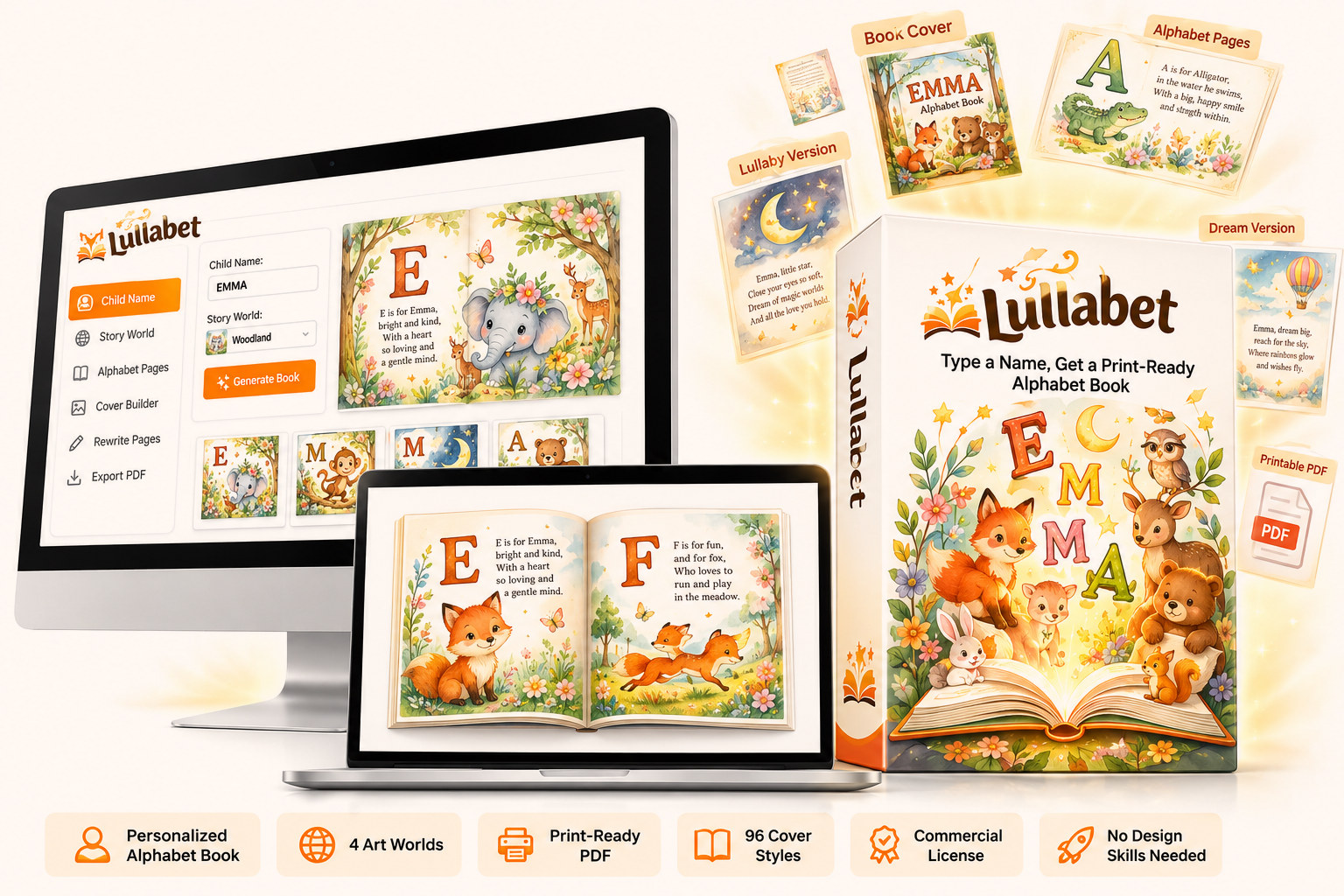
Deep-Dive Feature Breakdown: 4 Worlds, Dual Verses & Account Seeding
Lullabet provides four complete art styles inside the platform dashboard.
The first three styles—Moonlit Meadow, Watercolor, and Wildflower—apply distinct art treatments across classic alphabet animals.
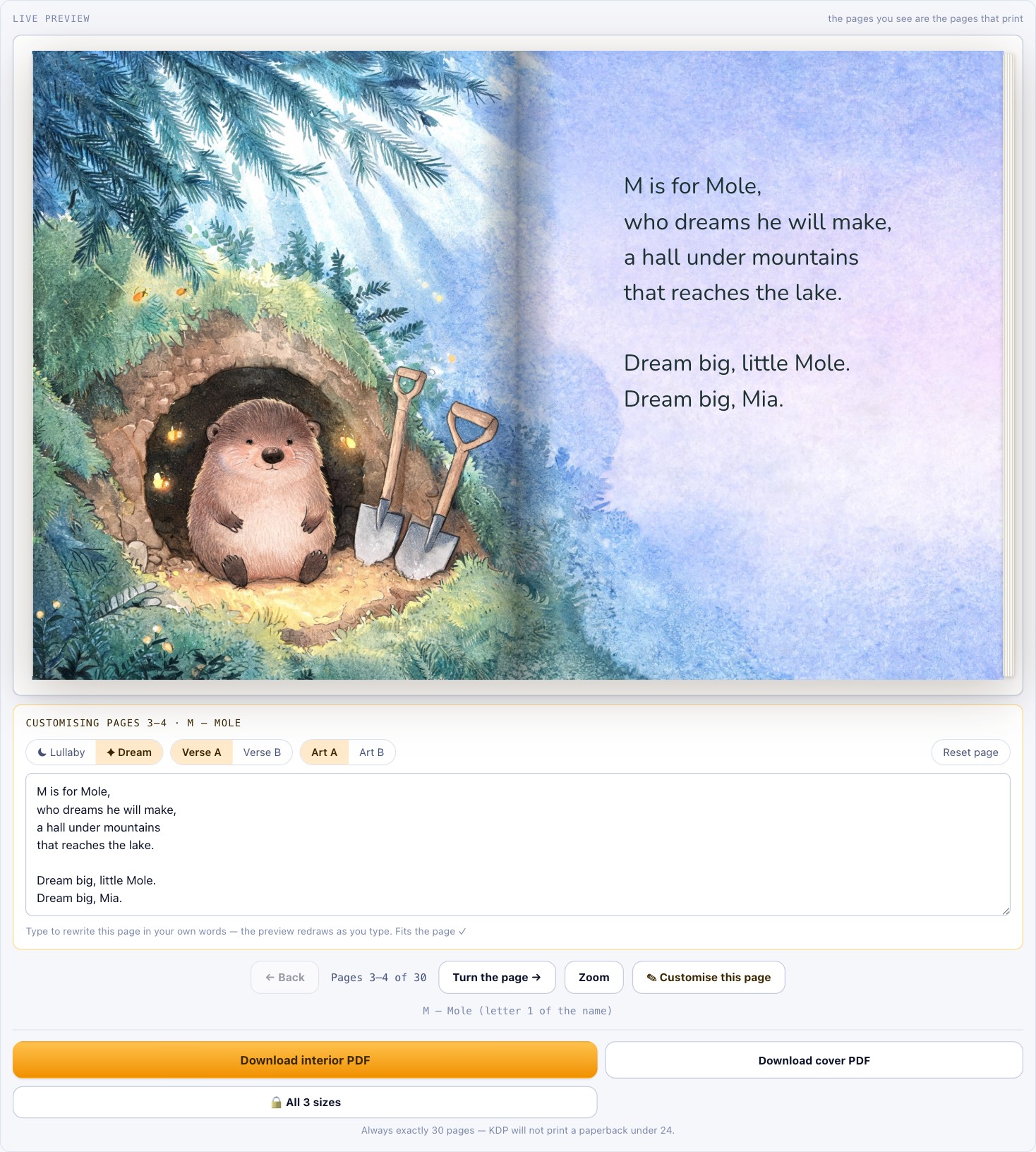
The fourth universe, called Woodland, changes the entire character roster with new animals for every letter like Mole and Nightingale.
Woodland includes 104 dedicated bedtime rhymes written specifically for its unique character cast.

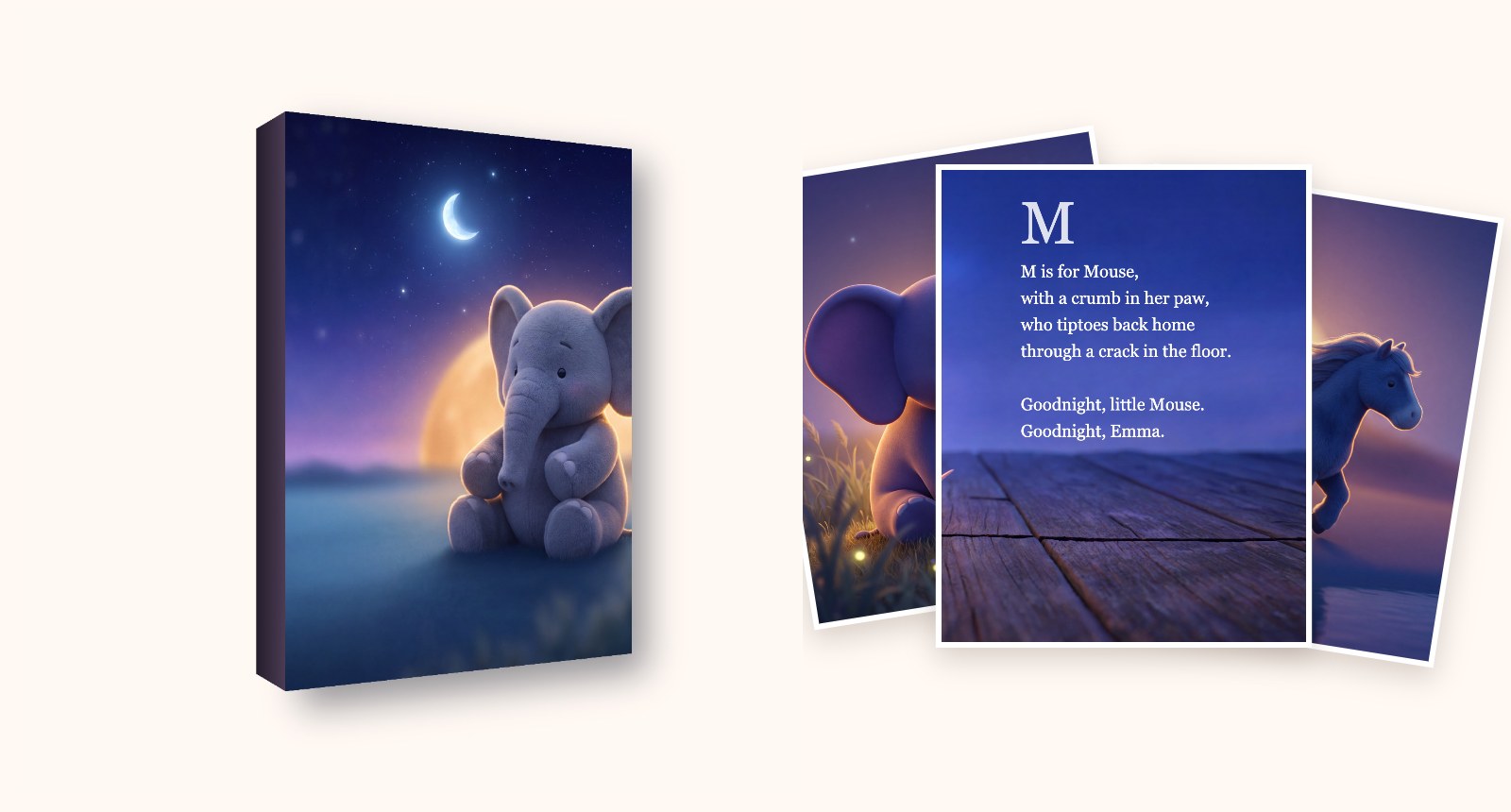
The system features 208 original verses split between two distinct tones: Lullaby and Dream.
Lullaby verses tuck animals in for bedtime, making them ideal for newborn baby shower gifts.
Dream verses focus on inspiring future achievements, catering directly to older kids starting school.
You can toggle between verse tones per page or rewrite entire lines inside the studio editor.
Another major highlight is account-level seeding technology built into the software architecture.
Your specific account key alters the internal letter selection algorithm and visual pairing logic.
If two separate publishers generate a book for the name “Emma”, they receive completely different layout file exports.
This technical safeguard prevents direct marketplace duplication among sellers using the system.
Furthermore, the studio automatically solves Amazon KDP page length rules by maintaining a rigid 30-page geometry.
Amazon KDP rejects physical paperback submissions containing fewer than 24 interior pages.
When generating short names like “Bo”, Lullabet automatically pads the manuscript with complementary bedtime spreads to meet print standards.
The Etsy vs. KDP Dual-Output System: One Sitting, Two Channels
A single name query inside Lullabet outputs two distinct PDF configurations for separate selling channels.
Output One: A heavy, print-ready PDF file engineered specifically for Amazon KDP print-on-demand publishing.
This file renders at 300 DPI resolution with full bleeds and exact spine dimensions calculated from page count.
File sizes range between 28 MB and 81 MB to maintain maximum visual crispness during physical printing.
Output Two: A lightweight digital edition tailored specifically for immediate Etsy fulfillment.
Etsy imposes a strict 20 MB file size upload cap on digital downloads.
Lullabet optimizes the Etsy copy down to 139 DPI, resulting in file sizes between 2.3 MB and 10.1 MB.
This dual-file workflow allows you to serve two completely different customer bases simultaneously.
You target physical book buyers on Amazon while simultaneously catering to last-minute printable shoppers on Etsy.
Is Lullabet Good for Etsy Sellers and KDP Authors? Pros and Cons
To provide a balanced perspective, let us review the objective advantages and clear limitations of this tool.
The Pros:
1. Unmatched Assembly Speed: Assembling complex 30-page manuscript PDFs takes approximately sixty seconds.
2. Zero Recurring Overhead: You pay a single $9.95 fee without facing monthly software subscriptions or per-book render credits.
3. Automatic Formatting Accuracy: The software handles print bleeds, trim standards, and calculated spine dimensions natively.
4. Commercial Selling Rights: You receive complete commercial rights to sell all generated books under your personal imprint.
5. Dual PDF Exporting: It generates high-res physical print files alongside lightweight digital download copies simultaneously.
6. Real-Time Text Editing: You can customize rhymes, swap story tones, or rewrite verse lines directly inside your web browser.
The Cons:
1. Fixed Trim Dimensions: The base software restricts manuscript sizes to standard 8.5 x 11 inch dimensions.
2. English Language Only: Story verses and character alphabets are currently locked exclusively to the English language.
3. Single Name Processing: Generating thousands of names automatically in bulk requires an optional dashboard upgrade.
4. Pre-Rendered Art Assets: You cannot upload personal image files to replace built-in animal character artwork.
Honest Limitations: What Lullabet Cannot Do (Exposing Reality)
As a senior analyst reviewing software platforms, I must address exaggerated marketing claims and set realistic expectations.
Lullabet is strictly a document assembly tool; it is not an automated sales system that generates income without effort.
The software will not drive store traffic, manage your customer service inbox, or research target keywords on Amazon.
Publishing books on marketplaces still requires creating compelling product titles, writing descriptions, and setting up keyword targets.
Additionally, while the artwork was pre-generated using professional AI workflows, it ships inside the software as static licensed assets.
You cannot export the character illustrations independently to sell as standalone clip art packs on stock marketplaces.
If you want to grab the active Lullabet discount code, remember that it grants access to the core book studio without recurring fees.
Pricing & Value Analysis: Is $9.95 Really All You Pay?
Many digital software products lure buyers in with low pricing only to lock essential features behind mandatory monthly plans.
Lullabet avoids that deceptive model by providing a complete lifetime commercial engine for $9.95 upfront.
There are no hidden rendering fees, no API key subscriptions, and no monthly credit top-ups required.
The underlying art assets were generated once by the developer and bundled directly into the studio codebase.
While optional upgrades exist post-purchase for bulk batching and additional listing tools, the core $9.95 license remains 100% complete.
You retain full rights to create unlimited books for unlimited names forever without paying royalties.
Furthermore, your purchase is backed by an unconditional 30-day money-back guarantee directly through email support.
Frequently Asked Questions About Lullabet
Do I need Adobe Photoshop, InDesign, or Canva to use Lullabet?
No, the studio runs entirely inside your modern web browser and exports fully finished PDFs with nothing to install.
Are there ongoing API expenses or monthly subscription fees?
No, there are no ongoing software fees, Midjourney API expenses, or monthly usage billing charges.
What happens if two users create a book for the exact same child’s name?
Thanks to built-in account seeding, different accounts generate distinct page layouts, visual pairings, and padding selections.
Will Amazon KDP accept the exported manuscript files without errors?
The exported PDFs conform strictly to KDP technical standards, including 300 DPI resolutions, full bleed boundaries, and 30-page minimums.
How long can names be before the layout breaks?
The studio accommodates names up to fourteen characters long while warning you visually if a name exceeds standard parameters.
Can I edit story rhymes or personalize the final dedication page?
Yes, every interior page features an interactive editing box that updates your live layout preview as you type.
Final Verdict: Should You Buy Lullabet in 2026?
Lullabet delivers exceptional functional value for self-publishers, print-on-demand creators, and Etsy store owners.
By automating layout formatting, character mapping, and spine math, it transforms a tedious task into a quick process.
At a single payment of $9.95 with commercial rights included, the return on investment is immediate upon making your first sale.
If you are willing to handle standard marketplace listing work, Lullabet provides an efficient solution for generating custom children’s books.
I strongly recommend taking advantage of the active launcher deal before standard pricing resumes.
If you have questions, I’m at admin@uprightreview.com and happy to help you evaluate software tools.