
Self-publishing digital romance storybooks on platforms like Amazon KDP, Etsy, and Gumroad has become one of the most profitable online side hustles, but creating long-form fiction from scratch usually takes months of frustrating labor. AI StoryForge promises to solve this bottleneck completely by offering a structured system of 313 romance blueprints powered by a portable prompt engine that works across ChatGPT, Claude, and Gemini. In this comprehensive evaluation, I dissect its prompt architecture, output quality across major AI models, and real publishing workflow to help you decide if it is truly worth your time and money.
So, What Exactly Is AI StoryForge?
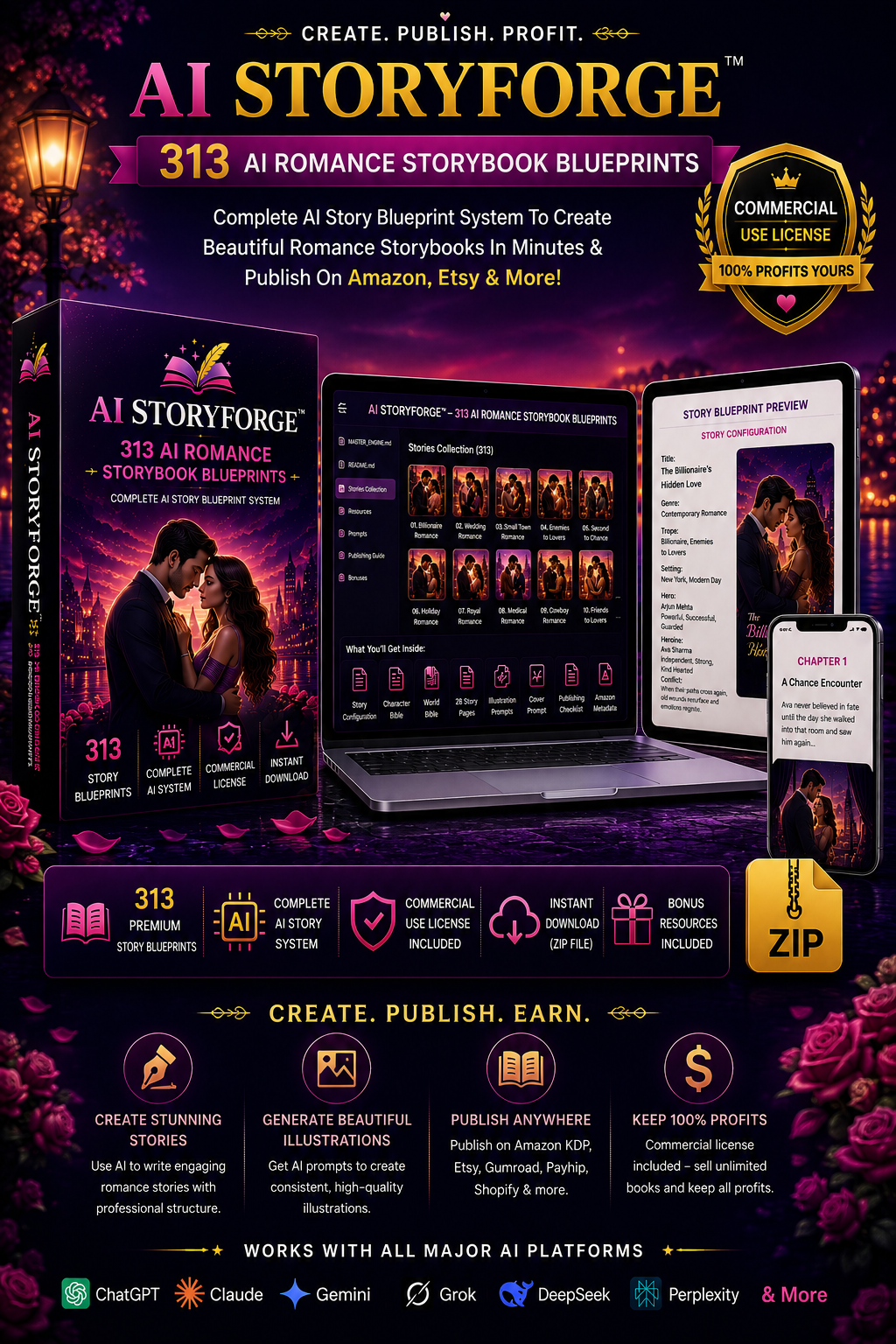
AI StoryForge is a structured prompt blueprint framework designed to turn standard artificial intelligence language models into automated, end-to-end storybook generation engines.
Step 1: Select one of the 313 included romance blueprints and copy the MASTER_ENGINE file into ChatGPT, Claude, or Gemini.
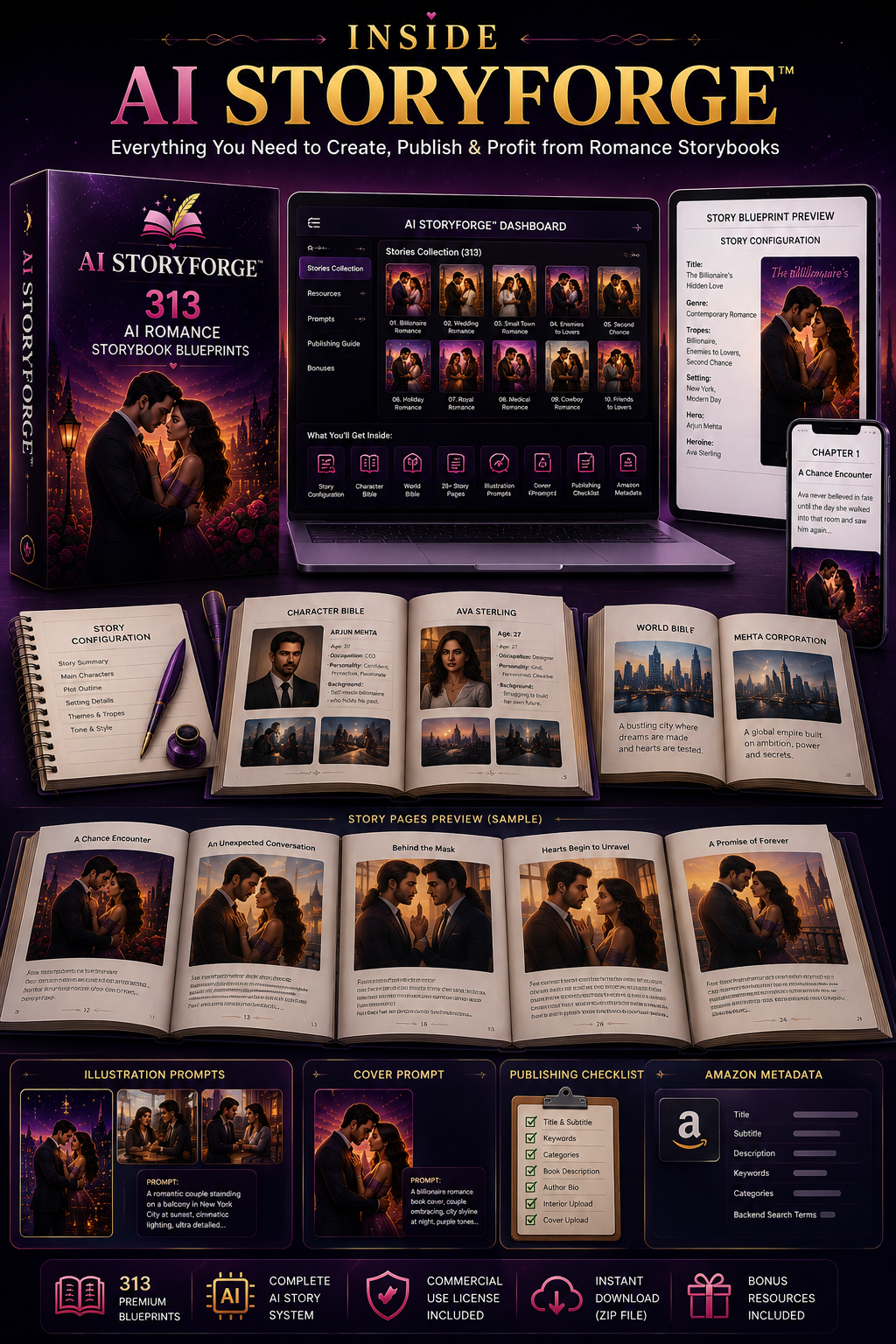
Step 2: Follow the guided conversational workflow as the AI automatically generates your Character Bible, World Bible, chapter outlines, page content, cover prompt, and visual illustration prompts.
Step 3: Combine your text and AI-generated artwork into an EPUB or PDF document, then publish it directly to marketplaces like Amazon KDP or Etsy with full commercial rights.
The first time I pasted a blueprint into Claude without tweaking any underlying settings, I fully expected generic text that would require heavy manual rewrites.
Instead, I watched the prompt engine systematically build a rich character backstory, set atmospheric scene parameters, and output remarkably coherent narrative pages with almost zero effort on my part.
AI StoryForge Honest Review: Unfiltering the $9 AI Publishing Engine
If you have spent any time in the digital self-publishing space recently, you already know that romance is the undisputed king of fiction sales.
Readers in romance sub-genres consume books at a rate that traditional authors simply cannot match on their own.
However, simply typing prompts like “write me a romance book about a billionaire” into ChatGPT yields repetitive tropes, flat dialogue, and catastrophic plot holes by chapter three.
The foundational pitch of AI StoryForge is that it replaces random prompting with a rigid structural framework known as the MASTER_ENGINE prompt architecture.
Rather than asking the large language model to write everything blindly in a single query, it forces the AI to execute a precise sequence of publishing steps.
I set out to test whether this system actually holds up under real-world testing conditions or if it is just another rehashed collection of generic AI prompts.
Over the course of three weeks, I ran multiple blueprints through OpenAI’s ChatGPT GPT-4o, Anthropic’s Claude 3.5 Sonnet, and Google’s Gemini 1.5 Pro to evaluate narrative depth, character voice, and formatting speed.
What I uncovered was a surprisingly disciplined framework that solves the primary issue plaguing AI fiction: narrative drift.
Hands-On Testing Results: Output Quality Across ChatGPT, Claude, and Gemini
To give you an honest appraisal of what this package delivers, I tested the exact same blueprint across three major AI engines.
My target blueprint for the experiment was taken directly from their Billionaire Romance category: “The Billionaire’s Second Chance.”
The workflow began by pasting the MASTER_ENGINE file into the chat window alongside the blueprint parameters.
First, I evaluated Anthropic’s Claude 3.5 Sonnet using the system.
Claude excelled dramatically at character voice and atmospheric descriptions, producing nuanced emotional tension between the lead characters without relying on cliché romance phrasing.
The Character Bible generated by Claude felt incredibly human, establishing deep psychological motivations and clear internal conflicts that carried through all chapter outlines.
Next, I tested OpenAI’s ChatGPT GPT-4o with the exact same blueprint sequence.
ChatGPT was noticeably faster at producing structured markdown code and organizing the page-by-page outputs cleanly.
While the prose felt slightly more direct than Claude’s emotional depth, GPT-4o followed the publishing metadata formatting impeccably, outputting Amazon keywords and category recommendations ready for copy-pasting.
Finally, I ran the test through Google’s Gemini 1.5 Pro engine.
Gemini handled the massive context window with ease, maintaining high memory retention for secondary characters introduced early in the World Bible setup.
However, I noticed Gemini occasionally required additional prompting to maintain strict formatting boundaries on page breaks.
Across all three models, the MASTER_ENGINE architecture performed its job: keeping the AI focused on one structural phase at a time so the narrative never lost its direction.
The MASTER_ENGINE Prompt Architecture & Visual Art Consistency
One of the hardest parts of creating illustrated storybooks or romance eBooks with visual covers is maintaining character consistency across multiple AI image generations.
If your female protagonist has green eyes and auburn hair in chapter one, standard image prompts often turn her into a blonde in chapter three.
AI StoryForge addresses this issue by generating dedicated visual prompt strings right alongside the manuscript text.

During the workflow sequence, the AI creates specific prompt seeds tailored for art tools like Midjourney, DALL-E 3, or Leonardo AI.
The Character Bible establishes detailed visual descriptors—such as facial features, clothing aesthetic, lighting moods, and color palettes—that are automatically baked into every subsequent illustration prompt.
I copied the generated cover prompt into Midjourney v6 to test the visual output quality.
The resulting artwork matched the tone of high-ranking Kindle Direct Publishing romance covers perfectly, featuring sharp typography placements and genre-accurate styling.
For creators looking to publish illustrated romance novellas on Etsy or printable storybooks for niche markets, this saved hours of frustrating trial-and-error in art generators.
You can also jump directly to see full AI StoryForge 2026 breakdown if you want to inspect how specific prompt strings are structured inside the Markdown files.
AI StoryForge Pros and Cons: A Transparent Breakdown
No software system is perfect, and as an independent reviewer, I insist on highlighting both the strengths and limitations of this package.
The Pros:
Massive Niche Library: Access to 313 story blueprints covering over 30 romance sub-genres (Billionaire, Island Romance, Travel, Wildlife, Diplomat, and more) means you never run out of story concepts.
Zero Model Lock-In: Because the system relies on portable Markdown (.md) prompts, you are not tied to a proprietary AI software that charges high monthly subscription fees.
Full Commercial Rights: You receive an unrestricted commercial license to publish, sell, and monetize every storybook you create on platforms like Amazon KDP, Etsy, Gumroad, Payhip, or your own Shopify store.
Structured Page Pacing: The MASTER_ENGINE prevents the AI from skipping plot points or ending chapters abruptly, resulting in complete, polished manuscripts.
Incredible Value Proposition: At the launch price of $9, you are getting a complete publishing system for less than the cost of a single stock illustration.
The Cons:
Requires Manual Copy-Pasting: This is an architectural prompt blueprint system, not a one-click automated software app. You must copy and paste prompts into your chosen AI interface.
Focused Primarily on Romance: While romance is the highest-grossing genre in self-publishing, creators seeking non-fiction or hardcore sci-fi blueprints will find limited utility here.
Third-Party Tool Reliance: You still need to generate cover images using an external tool like Midjourney or Canva and compile text into PDF/EPUB format using tools like Vellum or Atticus.
Real Publishing Workflow & Value Breakdown: Is $9 Worth It?
To help put this package into perspective, let us look at how AI StoryForge compares against standard methods of creating AI storybooks.
| Feature / Metric | AI StoryForge™ | Generic Prompt Packs | Random AI Prompting |
|---|---|---|---|
| Structural Control | MASTER_ENGINE.md Framework | Basic Text Lists | None (Ad-Hoc Queries) |
| Character & World Continuity | Dedicated Bible Systems | Rarely Included | Frequent Plot Holes |
| Visual Art Consistency | Integrated Image Prompts | Not Included | Random Art Styles |
| Metadata & Launch Package | Includes KDP Tags & Cover Prompts | Text Only | Must Create Yourself |
| Pricing Model | $9 One-Time Payment | $27 – $47 Recurring | Free (But High Time Cost) |
When you break down the individual components included in the package, the total real-world value is substantial.
Purchasing 313 story blueprints individually would easily cost $97 or more on digital asset marketplaces.
The MASTER_ENGINE prompt system carries an estimated standalone value of $49, while the Character and World Bible frameworks add another $58 in value.
Combined with the illustration prompts ($39), publishing checklists ($19), and unrestricted commercial rights, the total real value exceeds $262.
During the current introductory launch period, the entire system is available for a one-time payment of $9—representing over 96% in savings.
If you want to verify current promo availability, you can find active discount codes on our dedicated deals page.
Scam or Legit? Exposing the Reality of AI Romance Publishing
Whenever a digital product promises to help users publish books faster, skepticism is completely healthy.
There are countless scam courses online that claim you can click two buttons, publish AI garbage to Amazon, and instantly collect passive royalty checks worth thousands of dollars.
Let me be entirely transparent about realistic publishing expectations.
AI StoryForge is a legitimate asset toolkit, but it is not a magic money button.
Amazon KDP and Etsy have strict quality standards, and readers will quickly leave negative reviews if you publish unedited text with blatant AI phrasing.
The true value of this blueprint system lies in saving you 80% of the operational heavy lifting during story creation.
It generates robust outlines, deep character backstories, and structured chapter drafts, allowing you to spend your time polishing the prose, adding personal flair, and marketing your catalog.
Creators who treat AI StoryForge as a high-speed drafting assistant can realistically produce multiple high-quality romance titles per month.
Conversely, anyone who expects to generate raw text and upload it directly without reviewing the output will likely struggle to gain real traction with readers.
The vendor provides a straightforward 7-day satisfaction guarantee, allowing you to test the blueprint files risk-free before deciding whether to keep them in your workflow.
Final Verdict: Who Should Buy AI StoryForge?
After thorough testing across Claude, ChatGPT, and Gemini, AI StoryForge earns a strong recommendation for fiction creators and self-publishers.
If you are a Kindle Direct Publishing author, an Etsy printable seller, or a digital marketer looking to break into the booming romance genre, this framework provides an insanely cheap, structured shortcut.
For a single one-time payment of $9, getting 313 blueprints and the MASTER_ENGINE framework with commercial rights is an absolute bargain.
It eliminates the dreaded blank-page syndrome and replaces chaotic AI output with structured narrative discipline.
If you have questions about testing results or configuring prompt engines, I am always available at admin@uprightreview.com to help point you in the right direction.
Take advantage of the introductory pricing today, test the blueprints inside your favorite AI model, and start building your published book catalog step by step.